Challenges Facing the Next Generation of Scientists: Fact Check, Part 6
Bhattacharya claims to support early career scientists, but his policies undermine them.

“And for young researchers who are listening, there’s no policy instability that’s going to affect your career.... you’re going to have much more opportunities than you have had in the past.”
— Jay Bhattacharya, even though data show funding rates dropped from 26% in 2024 to just 19% in 2025
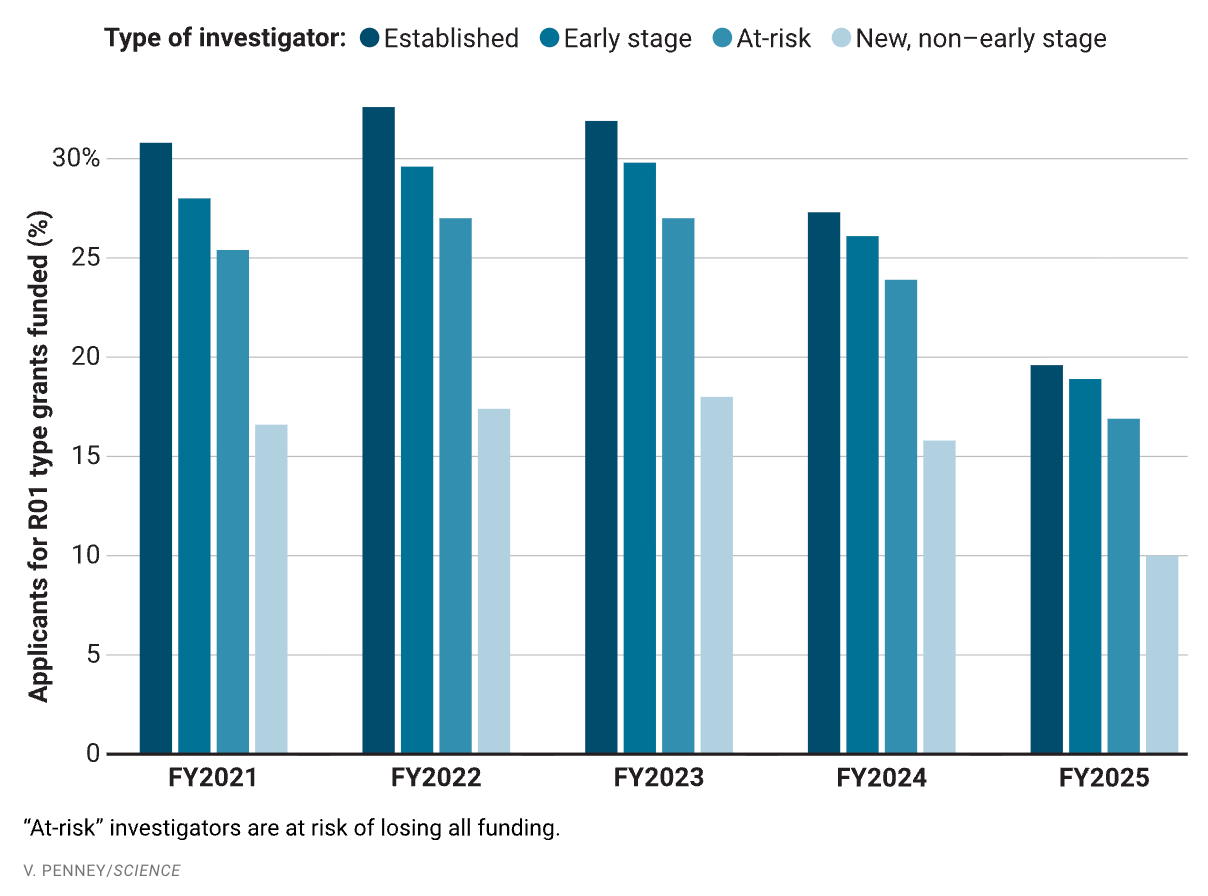
Photo credit: Science Magazine, https://www.science.org/content/article/nih-research-grant-success-rates-plummeted-2025
Pull up a chair, grab your popcorn and join us for part 6 of our fact check series of NIH Director Jayanta Bhattacharya, brought to you by current and recent NIH staff (*in our personal capacities*).
Today, we address how Jay Bhattacharya repeatedly claims to support early career researchers but instead implements policies that undermine them. He wraps it up with a nice cherry on top by gaslighting emerging scientists when they express concern for the future of science.
What Bhattacharya said
In response to Representative DeLauro:
“Sometimes for early career scientists, what you need is a front loaded grant, because they’re building their lab and so they can’t wait till year two or three to get the money to build the labs. So it’s scientifically justified to have it front loaded. And I’ve been focused on when we’re front loading to make sure that it has that scientific justification.”
In response to Representative Watson Coleman asking about recruiting diverse scientists:
“I think the key thing is empowering early career scientists with great ideas to have access to NIH funds, so that they can do their work.”
In response to Representative Pocan:
“And for young researchers who are listening, there’s no policy instability that’s going to affect your career.... you’re going to have much more opportunities than you have had in the past.”
What’s actually happening
The NIH Director repeatedly states that he supports early career scientists, when in fact his policies have undermined early career scientists. Bhattacharya has overseen the termination of thousands of grant awards to early career scientists. Early career scientists were disproportionately affected by terminations. In addition, as of August 2025, NIH terminated a majority of many training and transition awards, including 58% of F31 fellowship awards, 58% of F30 fellowship awards, and 66% of T34 institutional training awardees. Since then, NIH has elected not to renew many additional training programs, fully eliminating the T34 program. As a result of tightening pay lines and lost funds to terminations, academic training positions are dissolving as leading universities reduce PhD slots and labs rescind training positions. Almost two of every three U.S. universities reported fewer graduate student enrollments in 2025, while universities abroad reported increases. Under Bhattacharya, NIH will no longer recognize the UAW collective bargaining agreement for early-career researchers at the NIH, which undermines their career stability and working conditions. Early career researchers report feeling afraid for their careers and livelihood in this newly unpredictable funding environment. We now have a future generation of scientists who have been severely traumatized and their careers stunted, limiting the discovery of new ideas, cures and treatments.
What you can do
Stay informed!
Read the full fact check on the 27UNIHTED website.
Follow us here or on bluesky, instagram, linkedin, or facebook for up-to-date content on what’s happening inside NIH.
Look out for the next post in our fact check series on political interference at NIH.
Inform others! Share this post with your colleagues.
Call your members of Congress and urge them to enact protections for NIH, including stopping the discriminatory censorship of grants and applications at NIH
Leave a comment on the upcoming OMB proposed “Regulation for Federal Financial Assistance”
Need more ideas? Be on the lookout for our Advocacy Menu
About this Blog Series
Through this blog series, recent and current NIH staff (in our personal capacities) are fighting for scientific integrity at the NIH, so science can continue to yield future treatments for our fellow Americans. In these blogs, we are highlighting when Bhattacharya flagrantly mischaracterized, obfuscated, or just plain lied about the state of NIH under oath to members of Congress during the March 17 House Appropriations Committee hearing.
In case you missed it, we recently covered NIH’s ability to spend 2026 funds, the harmful consequences of the rapid transition to multiyear funding, and how discriminatory censorship of NIH grants is excluding many Americans from the benefits of science, political interference at NIH, and the leadership vacuum at NIH.